About Air Separation
Air separation is a mature field covering equipment that separates air to produce oxygen, nitrogen, argon and other gases. The main methods are cryogenic distillation, pressure swing adsorption and membrane separation.
1. Cryogenic distillation
Air is liquefied, then oxygen and nitrogen are separated by distillation in a column, based on their different boiling points. This is the most economical method for large plants and yields very high-purity products.

Small air separation units
Medium-pressure and full low-pressure processes deliver high purity, stable performance and high output, while reducing energy use and investment. Standard capacities include 150, 180, 300, 350, 600, 800 and 1000 m³/h, with custom design available. Instrument control may be by control cabinet, central control room or computer.

Medium and large air separation units
These use cryogenic processes with molecular sieve purification, booster expansion, structured-packing upper columns and full-distillation argon production. Capacities range from 1000 to 40000 m³/h. Designs can be tailored to site conditions and can produce gaseous or liquid oxygen and nitrogen, with full or partial recovery of argon, neon, krypton and xenon.
Evolution of the air separation process
| Generation | Process | Key characteristics |
|---|---|---|
| 1st | Aluminum-strip regenerators, high/low pressure | Complex process with auxiliary high-pressure air, caustic wash and ammonia pre-cooling; 0.66–0.9 kWh/m³ O2; oxygen recovery about 83% |
| 2nd | Stone-filled regenerators, full low pressure | Reaction turbine expander (up to 80% efficiency); oxygen purity 99.6%; 0.55–0.6 kWh/m³ O2; bulky equipment |
| 3rd | Reversing heat exchangers, full low pressure | Plate-fin exchangers reduce equipment size; oxygen recovery about 87%; 0.49–0.55 kWh/m³ O2; limited pure nitrogen output |
| 4th | Ambient molecular sieve purification | Front-end purification simplifies the cold box; continuous operation over 2 years; oxygen recovery 90–92%; 0.51–0.57 kWh/m³ O2 |
| 5th | Molecular sieve with booster expansion | Expander work boosts inlet air; oxygen recovery 93–97%; argon recovery 54–60%; 0.47–0.53 kWh/m³ O2 |
| 6th | Structured-packing upper column, full-distillation argon | Lower column resistance and compressor energy; oxygen recovery 97–99%; argon recovery 65–84%; 0.37–0.43 kWh/m³ O2; DCS control |
| Internal compression | Liquid oxygen pump compression | No oxygen compressor, so no high-temperature gaseous oxygen and lower fire risk; standby pump reaches load within 10 seconds; unit energy about 3–7% above external compression |
2. PSA nitrogen generation
PSA nitrogen generators use carbon molecular sieve as the adsorbent. Under pressure, oxygen diffuses into the sieve pores much faster than nitrogen, so nitrogen is concentrated in the gas phase. Programmable valves alternate two adsorption towers between pressurized adsorption and depressurized desorption, followed by nitrogen purge regeneration.
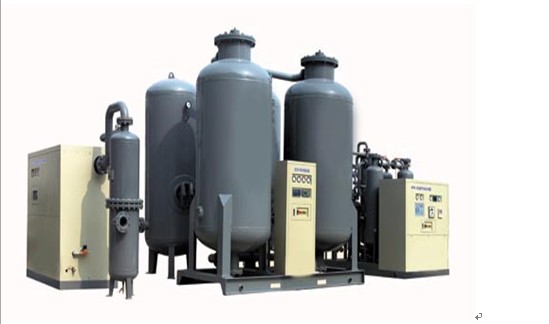
- Capacity: 10–3000 Nm³/min
- Working pressure: 0.4–0.8 MPa
- Nitrogen purity: ≥ 99.9995%
- Oxygen in product nitrogen: ≤ 1 ppm
- CO2 in product nitrogen: ≤ 1 ppm
- Product dew point: -60 °C (atmospheric pressure)
PSA alone typically yields 99–99.9% nitrogen; a nitrogen purifier removing trace oxygen and water raises purity above 99.999%.
Features
- Low energy consumption and operating cost
- Simple structure and small footprint
- Microcomputer control: qualified nitrogen in about 30 minutes, with unattended operation
- Eliminates cylinder changes and delivery costs, and is safer to use
Applications
- Metal heat treatment: carburizing, carbonitriding, bright annealing, powder metal and magnetic material sintering
- Oil, gas and chemicals: pipeline and vessel purging, nitrogen injection, process blanketing
- Electronics: nitrogen protection in semiconductor and component production
- Coal mining: underground fire prevention
- Food and beverage: modified-atmosphere packaging, preservation, wine storage
- Pharmaceuticals: nitrogen-blanketed storage of materials and medicines, herb protection
- Glass: float glass protection